
Cluster slot diagrams: touching at a corner may not connect two groups
Matching symbols can touch diagonally without sharing a side. If a cluster rule counts only side-connected symbols, that corner touch does not join them into one group.
For the topic overview, see Do line patterns or adjacent reels count?.
The word adjacent needs a definition. Counting every matching icon on the screen before checking that definition can produce a cluster that the rules never describe.

State the connection rule before counting
Pragmatic Play’s Fruit Party announcement supplies a real example of the cluster-style format. The small diagram in this article is our own model, not Fruit Party’s actual grid or complete rule set.
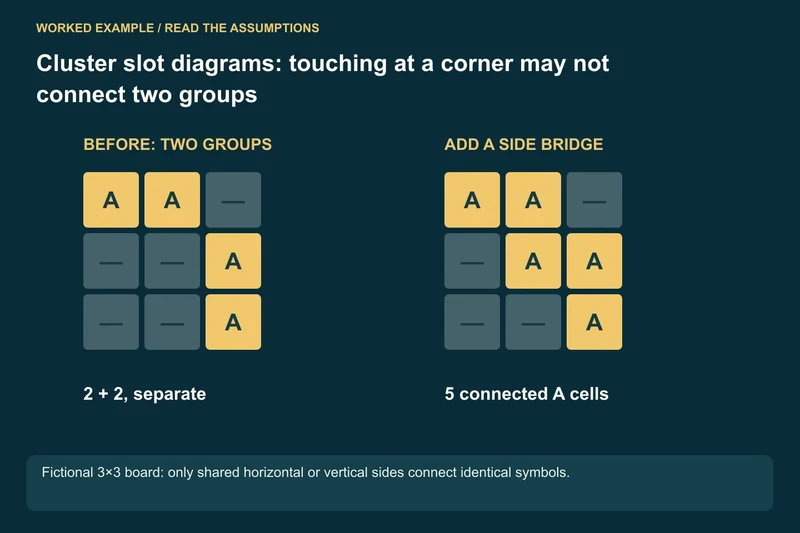
Assume a fictional game connects identical symbols only through shared horizontal or vertical sides. Corner-only contact is excluded. We also assume no Wilds, bridges, wraps or other special modifiers. These conditions are part of the exercise, not universal slot rules.
Trace a path through the matching cells
| Row | Column 1 | Column 2 | Column 3 |
|---|---|---|---|
| 1 | A | A | — |
| 2 | — | — | A |
| 3 | — | — | A |
The two A symbols in row 1 share a side, forming a group of two. The A symbols in column 3, rows 2 and 3, form another group of two. Row 1 column 2 touches row 2 column 3 only at a corner. Under the stated rule, the four symbols are not one connected group.
One added bridge changes connectivity
Now change row 2 column 2 to A. It shares a side with row 1 column 2 and with row 2 column 3. The new cell connects the two original groups into one five-cell group. Count that bridge once, not once for each group it touches.
This is a change in the board, not proof of a payout. If the game also requires a minimum count, symbol class or another condition, those checks follow separately. Our example supplies no paytable value.
A repeatable paper check
Start at one matching cell. Mark it visited, then visit matching cells reachable across allowed sides. Continue until no new cells can be reached. The visited set is one connected group under this model. Start again from an unvisited matching cell to find another group.
If the actual rule permits diagonals, the first grid may be evaluated differently. Save that rule with the screenshot rather than borrowing the connection model from another title. The diagram explains how a specified rule changes the count; it does not predict the next board or claim an award for a real round.
The phwin homepage brings together the site’s other reading topics.
Source-based editorial research and original examples. Sources checked 9 October 2026. No real-money play or account transaction was performed for this article.