
PAGCOR’s first-half 2026 revenue fell 26.64%: where the ₱15.73 billion drop came from

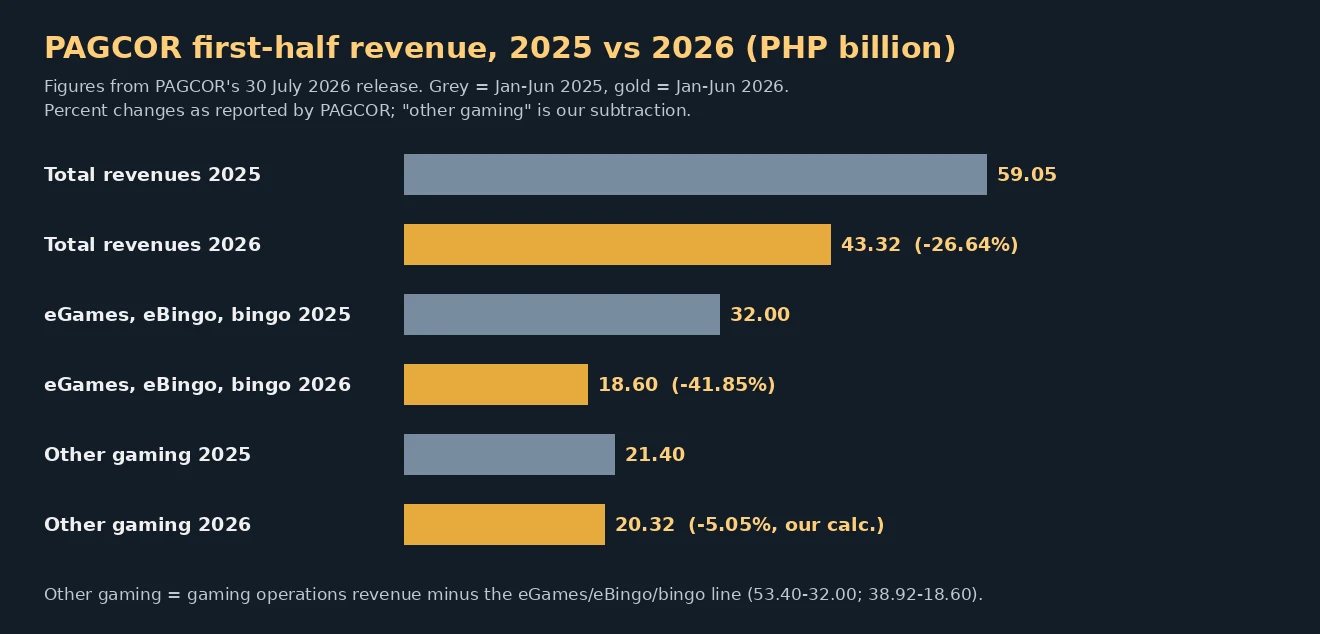
Short answer — The Philippine Amusement and Gaming Corporation (PAGCOR) reported on 30 July 2026 that its total revenues for January to June 2026 were ₱43.32 billion, down 26.64% from ₱59.05 billion a year earlier. That is a drop of ₱15.73 billion (our calculation). Most of it came from one line: revenues from eGames, eBingo and bingo grantees fell 41.85%, from ₱32 billion to ₱18.60 billion. Net income fell 85.29% to ₱1.58 billion, which PAGCOR attributed mainly to larger mandated remittances to the Philippine Sports Commission. PAGCOR still reported ₱30.16 billion in contributions to nation-building for the half.
This guide breaks the release into its parts, adds the subtractions PAGCOR did not print, and explains how this corporate revenue figure differs from the industry’s gross gaming revenue, which PAGCOR reports separately.
What exactly did PAGCOR report for January to June 2026?
| Line (PAGCOR’s wording) | H1 2025 | H1 2026 | Change reported |
|---|---|---|---|
| Total revenues | ₱59.05B | ₱43.32B | −26.64% |
| Revenues from gaming operations | ₱53.40B | ₱38.92B | −27.11% |
| eGames, eBingo and bingo grantees | ₱32B | ₱18.60B | −41.85% |
| Licensed casinos | not stated | not stated | −3.85% |
| PAGCOR-operated casinos | not stated | not stated | −8.67% |
| Net operating income | not stated | ₱31.75B | −35.05% |
| Net income | not stated | ₱1.58B | −85.29% |
| Remittance to the Philippine Sports Commission | ₱1.26B | ₱2.01B | +58.68% |
PAGCOR Chairman and CEO Alejandro H. Tengco said the decline was “largely driven by weaker revenues from the electronic gaming segment”. He linked the first-quarter weakness to geopolitical tensions in the Middle East that “dampened consumer spending”, and said that while conditions improved in the second quarter, uncertainties remained, including higher global fuel prices.
Which part of the business caused the drop? (our calculation)
The release gives three totals that let us separate the electronic segment from everything else. Gaming operations minus the eGames/eBingo/bingo line leaves the rest of PAGCOR’s gaming revenue, mostly casinos:
- Electronic gaming line: ₱32.00B → ₱18.60B, a fall of ₱13.40B.
- All other gaming revenue: ₱53.40B − ₱32.00B = ₱21.40B in 2025, and ₱38.92B − ₱18.60B = ₱20.32B in 2026. That is a fall of ₱1.08B, or 5.05%.
- Non-gaming revenue: total minus gaming operations, ₱5.65B → ₱4.40B, a fall of ₱1.25B, or 22.1%. PAGCOR does not describe what this line contains.
Put together, the electronic line accounts for ₱13.40B of the ₱15.73B total decline, about 85% (our calculation). Its share of PAGCOR’s gaming revenue shrank from 59.9% to 47.8%, so in 2026 casinos and other gaming sources became the larger half again. Read that carefully: it is a statement about PAGCOR’s revenue mix, not about how many people play online or in casinos.
Small rounding differences worth knowing
If you recompute the percentages from the rounded peso figures, three come out slightly different from PAGCOR’s: gaming operations −27.12% (PAGCOR: −27.11%), the electronic line −41.87% (−41.85%) and the PSC remittance +59.52% (+58.68%). The listed remittance items also add up to ₱30.15B against the stated ₱30.16B total. These gaps are consistent with PAGCOR rounding the underlying amounts, such as “Php32 billion” and “Php1.26 billion”, and do not change the picture. We quote PAGCOR’s own percentages wherever they exist.
Was the slide already visible in 2025?
PAGCOR’s full-year 2025 release of 30 January 2026 helps here. It reported ₱53.33B for the whole of 2025 from eGames, eBingo and bingo grantees, and said other revenue streams, “including interest earnings, income, and service fees”, added ₱10.88B. Subtracting the first half (₱32.00B) leaves ₱21.33B for July to December 2025 (our calculation). In other words, the electronic line had already fallen by a third between the two halves of 2025, before the Middle East tensions that PAGCOR cites for early 2026. Against that second-half base, the ₱18.60B for January to June 2026 is a fall of about 12.8%, not 41.85%. Back in January, Tengco described the opposite trend, with land-based revenue declining as “more customers” moved to “digital and online gaming platforms”; the 2026 figures no longer fit that description.
Why did net income fall much faster than revenue?
Revenue fell by about a quarter, but net income fell by 85.29%. Working backwards from the reported percentage, first-half net income in 2025 would have been around ₱10.74B (our estimate: ₱1.58B ÷ 0.1471). PAGCOR’s explanation is the Supreme Court ruling that requires it to remit five percent of its gross income to the Philippine Sports Commission “instead of the previously adopted computation”. The PSC payment rose to ₱2.01B from ₱1.26B.
That ₱0.75B increase alone does not explain a drop of roughly ₱9 billion in net income, and the release does not give a full income statement, so the rest of the gap cannot be traced from this document. What the numbers do show is that PAGCOR’s costs and mandated shares did not fall as fast as its revenues.
Where did the ₱30.16 billion for “nation-building” go?
| Recipient or item | H1 2026 | Share of ₱30.16B (our calculation) |
|---|---|---|
| National Government 50% share | ₱18.49B | 61.3% |
| Socio-civic projects | ₱7.36B | 24.4% |
| Philippine Sports Commission | ₱2.01B | 6.7% |
| 5% franchise tax | ₱1.94B | 6.4% |
| Host cities share | ₱340.05M | 1.1% |
| Corporate income tax | ₱9.87M | under 0.1% |
| Athlete incentives under RA 10699 | ₱4.47M | under 0.1% |
The ₱30.16B equals 69.6% of the half-year’s total revenues (our calculation), which shows how much of PAGCOR’s income is committed before anything is left as profit.
How does this differ from the industry’s gross gaming revenue?
PAGCOR publishes two different kinds of number, and they are easy to mix up. The first is its own corporate revenue, discussed above. The second is the gross gaming revenue (GGR) of the whole licensed industry. PAGCOR reported industry GGR of ₱87.60B in the first quarter (down 15.87%) and ₱88.13B in the second quarter (down 20.33%).
Adding the two quarters gives first-half industry GGR of ₱175.73B against ₱214.75B a year earlier, a fall of 18.17% (our calculation). PAGCOR’s own gaming revenue of ₱38.92B is about 22% of that industry figure. Its eGames/eBingo/bingo revenue of ₱18.60B compares with ₱79.75B of electronic-gaming GGR across the two quarters. These are ratios between published totals, not PAGCOR’s fee rates, which the releases do not state. The comparison does show one thing clearly: PAGCOR’s electronic revenue fell much faster (−41.85%) than the overall industry GGR (−18.17%).
Did the second quarter really improve?
Tengco said market conditions “improved in the second quarter”. The industry GGR releases support that only in part, so it is worth setting the two quarters side by side.
| Industry GGR segment | Q1 2026 | Q2 2026 | Q2 vs Q1 (our calculation) |
|---|---|---|---|
| Licensed casinos | ₱44.52B (50.83%) | ₱45.37B (51.49%) | +₱0.85B |
| Electronic gaming (E-Games, E-Bingo, bingo, poker) | ₱39.90B (45.55%) | ₱39.85B (45.21%) | −₱0.05B |
| PAGCOR-operated casinos | ₱3.17B (3.62%) | ₱2.90B (3.30%) | −₱0.27B |
| Total | ₱87.60B (−15.87% y/y) | ₱88.13B (−20.33% y/y) | +₱0.53B (+0.6%) |
In pesos, the second quarter was slightly larger than the first, driven by licensed casinos. Against the same quarter of 2025, though, the decline deepened from 15.87% to 20.33%, because the second quarter of 2025 had been the stronger base (₱110.63B against ₱104.12B). Both readings are correct; which one sounds like “improvement” depends on the comparison chosen. The electronic segment was flat between quarters, at just under ₱40B each time.
What does this mean for players in the Philippines?
For an individual player, a revenue report changes nothing about the rules of play. It does explain why regulation is in the news: the electronic segment carries most of the decline, and PAGCOR has said it will keep focusing on “sound regulation” with industry stakeholders. Before playing anywhere online, check that the platform appears as licensed at pagcorguarantee.ph. PAGCOR’s responsible gaming page states that persons under 21 are prohibited from playing on any online gaming platform, and lists the National Problem Gambling Helpline at (02) 8248 9568.
Not yet confirmed: the peso amounts behind the casino percentage changes, the full-year outlook, and the reasons for the rest of the net-income decline beyond the PSC remittance. PAGCOR’s audited figures may differ from these release numbers.
Sources (checked 22 October 2026): PAGCOR headline releases of 30 July 2026 (first-half revenues), 16 May 2026 (Q1 industry GGR) and 10 August 2026 (Q2 industry GGR); PAGCOR responsible gaming page. All subtractions, shares, the implied 2025 net income and the first-half GGR total are our own calculation from these releases.