
Payline direction: why an A–A–A group can still fail
Published — UTC

Three identical symbols next to one another do not necessarily form a payline win. A line rule can require the sequence to begin at a particular reel and run in a specified direction.
Read the same line under two instructions
Our invented five-reel line reads B C A A A from left to right. Rule L requires at least three A symbols consecutively from reel 1. Rule R requires them consecutively from reel 5, reading right to left.
| Rule | Starting symbol | Qualifying A run from that start | Pass? |
|---|---|---|---|
| L: start at reel 1 | B | 0 | No |
| R: start at reel 5 | A | 3 | Yes |
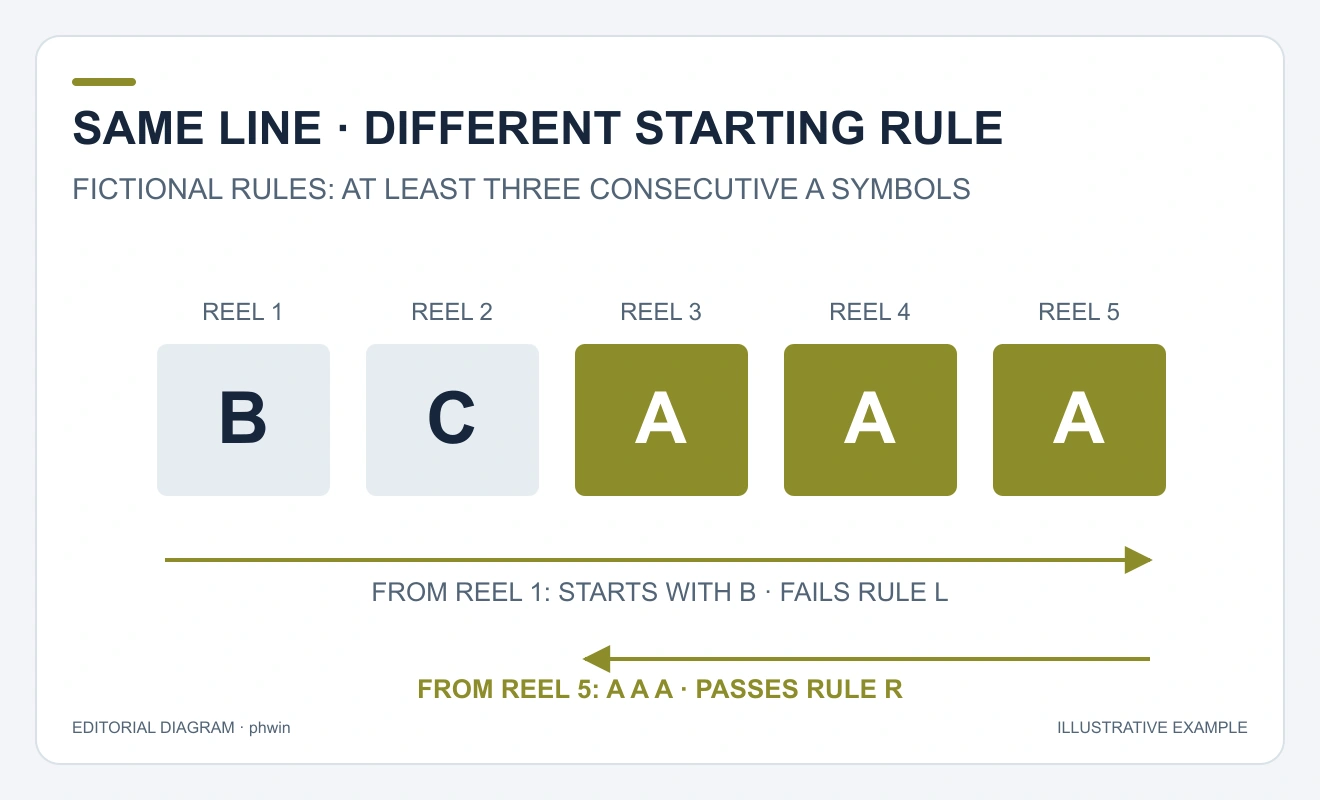
The image is unchanged. Only the stated rule differs. A’s adjacency on reels 3–5 cannot repair the missing A at reel 1 under L.
A symbol count and a line path are separate checks
First identify the line’s exact positions. Then test the starting reel, direction, length and any permitted substitution. A count across different rows may belong to a ways or anywhere rule, but cannot silently be substituted for a specified line path.
The British game-rules reference provides disclosure context. The two directional rules here are invented, not verified provider configurations.
Follow the selected path before testing the sequence
A payline may change rows between reels. Consider a fictional path through row positions 2, 1, 2, 3, 2 on reels 1 to 5. Take exactly one symbol from each specified position, in that order. An A elsewhere on reel 1 does not replace the B located on the selected path.
Write down the extracted five-symbol sequence before applying the directional rule. This separates two possible mistakes: reading the wrong cells and applying the wrong starting condition to the right cells. Counting all A symbols across the whole screen can conceal both errors.
Substitution must follow its own rule
If the sequence were W, A, A, C, B, a left-starting three-A match would depend on whether W is allowed to substitute for A at that position. A Wild label alone does not establish exceptions for special symbols, blocked reels or a particular mode. Check those conditions rather than silently changing W into A.
Likewise, a rule that pays from both ends does not automatically mean every overlapping sequence is paid twice. The combination and award rules must say how qualifying results are combined. Our L-versus-R comparison tests eligibility only and supplies no paytable amount.
A five-part line review
- Record the exact title, mode and settled round identifier.
- Identify the line number and its row position on every reel.
- Extract the symbols along that path.
- Apply the stated start, direction, minimum length and substitution rules.
- Only then use the applicable paytable and compare the recorded award.
If the path diagram or rule is missing, report the visible sequence and the missing evidence separately. “Three A symbols are adjacent” is an observation; “this line must pay” requires the additional conditions above.