
There are three identical symbols but no match? Check start, line and interval
It’s not enough to see three A’s on the screen. It may be on the wrong payline, start on the wrong reel, or have a gap between reels that the rule requires. Use the exact pattern before counting the winning combination.

First the location, then the number. For a payout question, the full title, mode, symbol rule and pattern definition are required. The visible count across the screen is different from the count qualified on a line or consecutive reels. Here’s how to see where two numbers diverge.
“Lines” and “ways” are not the same in the source
In Pragmatic Play’s Wild West Duels information sheet, page 4, states 15 lines, left-to-right direction and only one highest winner per line. The line map and aggregation rule are important when it comes to that game itself.
Meanwhile, the Master Tiger overview by JILI is labeled 243 ways and is described as requiring three or more symbols from left to right. This shows why the description should be read along with the field label: the page heading is “Paylines”, but the value is “243 ways”. Don’t turn your note into 243 fixed drawn lines just because of the heading.
The two sources are specific products, not two configurations tested on phwin. They do not verify availability on an account. The next grid is its own model for analysis; This is not a screenshot, line map or replay of any game.
Own worked grid: same A, different qualification
Let’s use a fictional grid with three rows and five reels. Only A is checked; B is filler that is not included in the calculation. There are no wilds, scatters, multipliers or special exceptions in this model.
| Row | Reel 1 | Reel 2 | Reel 3 | Reel 4 | Reel 5 |
|---|---|---|---|---|---|
| Above | A | B | B | B | A |
| Middle | B | A | B | B | B |
| Below | B | B | A | B | B |
Let’s compare the two deliberately defined rules. In Rule L, only three straight horizontal lines are active; need at least three A’s from reel 1 in the same row. In Rule W, A can be any row on each reel, but at least three consecutive reels are required starting from reel 1. Both checks are left to right.
In Rule L, no qualifying A line. The top is A–B–B on the first three reels; nor is the middle or bottom A–A–A. Diagonal A is not an active line in this model.
In Rule W, there is one A each on reels 1, 2 and 3. So there is 1 × 1 × 1 = 1 qualifying three-reel combination. The A’s don’t have to be in the same row because that’s what the rule allows. This is only a qualification; no payout amount is assigned to the model.
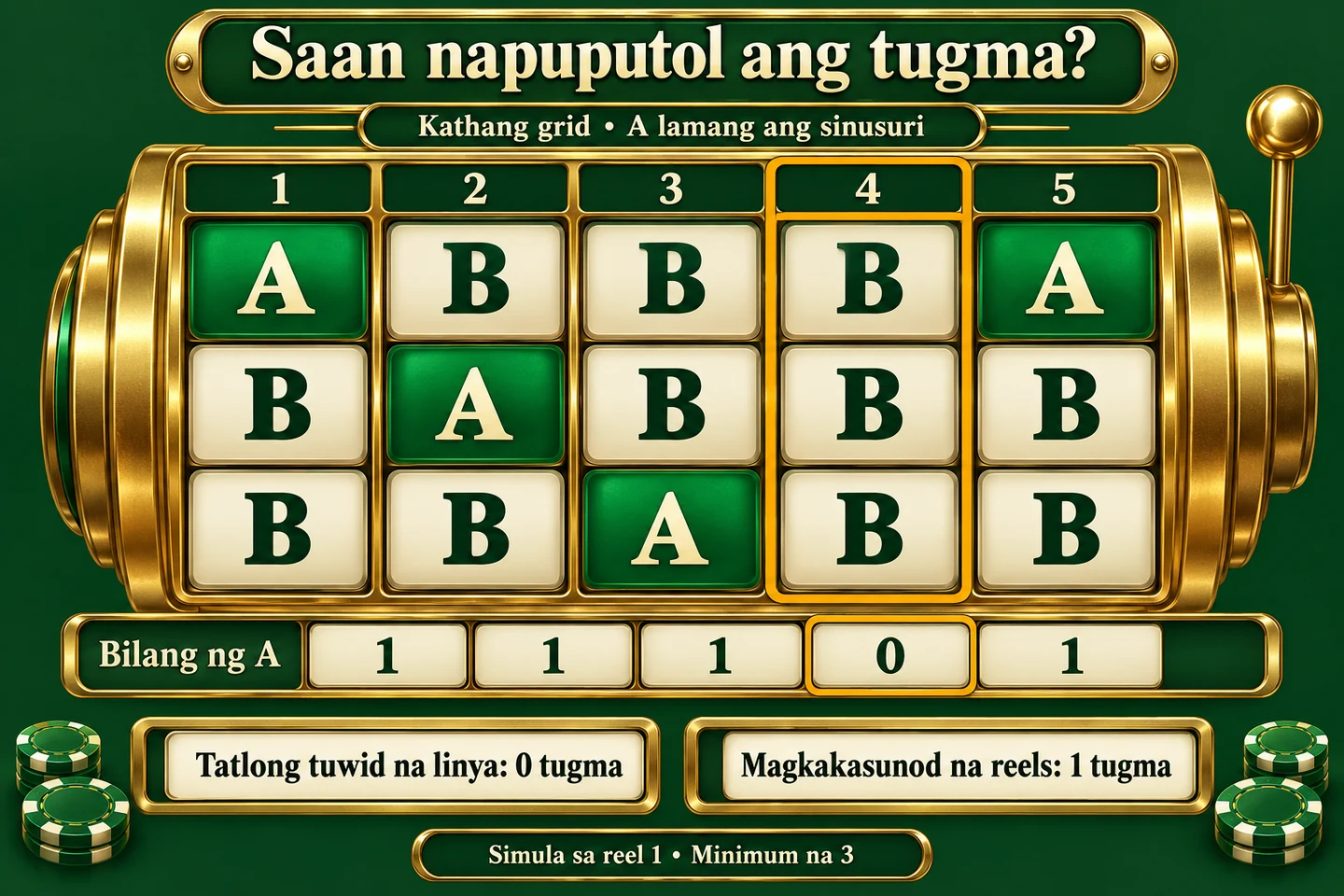
There are four A’s on the screen, but only three reels are continuous
The number of A per reel is 1, 1, 1, 0, 1. The streak ends on reel 3 because there is no A on reel 4. The zero cannot be skipped to attach the A to reel 5 and call it a four-reel combination. The fourth A across the screen is not the fourth reel in a row.
Nor should you multiply all five counts—1×1×1×0×1=0—and say there aren’t any qualifying combinations. In Rule W, there is a minimum of three and a three-reel match is allowed. Zero prevents extending beyond reel 3; it does not erase the qualifying three-reel run. If the actual rule requires five reels, the answer is different. So the minimum length must be included in the note.
“There is a match” and “how much is the award” are also different. After determining the eligible length and number of combinations, the correct symbol value, stake base and aggregation rule will be used. The word ways is not enough to calculate the cash payout.
Try changing the paper placement
First, move A on reels 1 and 3 to the middle row, while A remains on reel 2 and reel 5. The middle of the first three reels will be A–A–A. In Rule L, there is now a qualifying horizontal line. In Rule W, a three-reel combination is still one. The A count is the same per reel; only the line result has changed because the row path is important here.
Second, use a separate snapshot with A on reels 2, 3, 4 and 5 but not on reel 1. There are four consecutive occupied reels, but there is no qualifying A combination in either of our two rules, because they both implicitly start on reel 1. We do not apply this condition to all games: if pay-anywhere, a different direction or a different starting rule is in the help, a different analysis is required.
Both changes are paper exercises. No paid spins or live outcomes are used, and there is no indication that one format has better results. The number of paths is not a probability table.
Four details before asking about payout
- Game and mode. Write the full title, provider and feature state. Do not use the pattern of another variant.
- Eligible patterns. Is there an active line map, or matching symbols on adjacent reels? If lines, record the path itself; not every visible diagonal is automatically valid.
- Start, direction and minimum. Specify starting reel, left/right or other direction, and minimum length. Mark where the run was first cut.
- Symbol exceptions and award rules. Read the wild, scatter, highest-only rule and payout base separately. Do not include special symbols in ordinary multiplication if that is not allowed.
If the payout in the history does not match, save the round identifier, time and relevant rules page. In the content question, the grid can be described without sharing the account details. In account settlement, the verified support of the operator itself is required.
When the reel heights change, also separate potential ways from actual winning ways.
May explanation of paylines and adjacent reels and comparison worksheet for more extensive notes. The format overview can be found at slots hub and the other subject in guide library of phwin homepage. For guidance correction, use the phwin contact.