
Three-digit rearrangements: why 112 gives three sequences, not six
Rearranging three digits produces six distinct sequences only when all three values are different. With the digits 1, 1 and 2, the distinct sequences are 112, 121 and 211. Swapping the two identical 1s does not produce another result.
This worked example in the phwin lottery section separates a list of rearrangement operations from the distinct strings it represents. The digit model is fictional; it states no real product’s purchase format, winning category or payout.
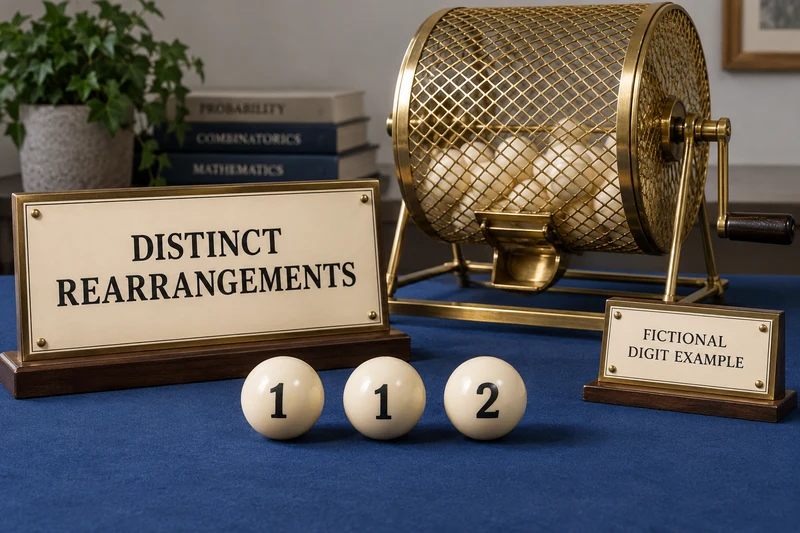
Temporarily label the identical objects
Imagine the two 1s carry labels A and B, so the three objects are 1A, 1B and 2. There are six ways to arrange those labelled objects. But the result string records the digit value, not the temporary label.
| Labelled arrangement | Recorded digit string |
|---|---|
| 1A, 1B, 2 | 112 |
| 1B, 1A, 2 | 112 |
| 1A, 2, 1B | 121 |
| 1B, 2, 1A | 121 |
| 2, 1A, 1B | 211 |
| 2, 1B, 1A | 211 |
Each distinct string appears twice in the labelled list. Removing the artificial A/B distinction leaves three unique strings. This is a counting correction, not a claim that a charged duplicate entry disappears from a payment history.
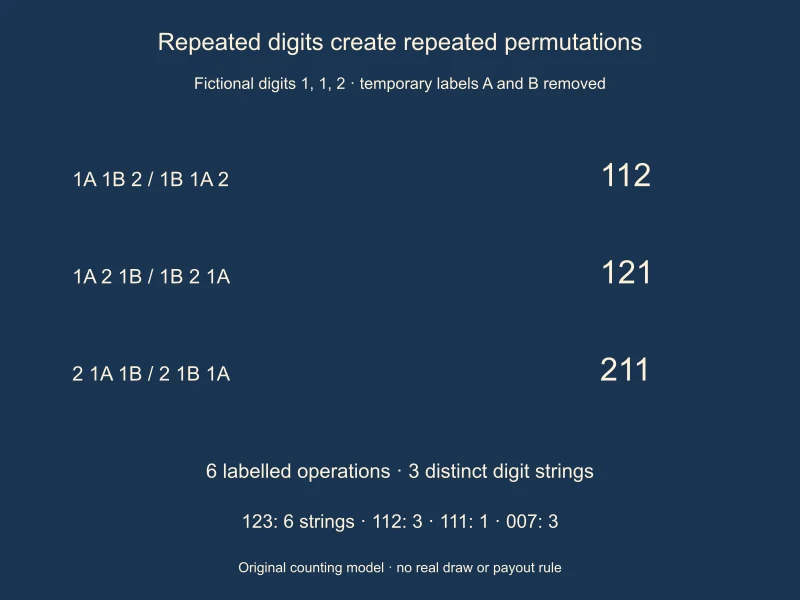
Check all three repetition patterns
For 123, all values differ, giving 123, 132, 213, 231, 312 and 321: six distinct strings. For 112, one value appears twice, giving three. For 111, every rearrangement still reads 111, giving one.
OpenStax’s counting principles describes permutations of indistinguishable objects by dividing the labelled arrangement count by the factorials of the repeated groups. Applied to our own examples, the counts are 3! = 6, 3!/2! = 3 and 3!/3! = 1.
We generated the six labelled-position permutations for each example, converted them back to strings and counted unique values. That enumeration agrees with the formula. It also makes the source of the duplicate count visible.
Keep leading zeros and repeated values
The digits 0, 0 and 7 give 007, 070 and 700. They still represent three-position strings in this model. Converting 007 to the ordinary number 7 would discard information needed to compare positions.
Do not remove a repeated digit as though you were creating a set of values. The digits 1, 1 and 2 are a multiset: the second 1 is part of the required three-position composition. Reducing them to {1,2} changes the original record and the question.
A larger family is different from one exact string
In an explicitly uniform model allowing every ordered string from 000 to 999, a specific string represents one of 1,000 outcomes. The three-string family {112,121,211} represents three outcomes, while the six-string family based on 123 represents six.
That comparison is about different event sizes. It does not make a specific 112 more likely than a specific 123; each exact string still represents one outcome. The probabilities require the uniform model, which this article does not establish for any real draw.
The existing duplicate lotto-line guide makes a related distinction between paid records and unique unordered six-number sets. Its sorting rule cannot be used to erase order in an ordered-digit product.
Use the right comparison key for the rule
If the product requires exact order, compare the full original string. If a verified rule accepts any rearrangement of the same digits, a sorted three-character string can identify the family while preserving repetitions and leading zeros. Do not infer that second rule from a word such as “box”, “mix” or “ramble” without the actual definition.
Keep product identity, event identity, original string, rule-defined comparison key and confirmed charges separately. The mathematical family size does not establish accepted entries, refunds, awards or prize sharing.
All examples are fictional and the unique-string enumeration was checked on 10 October 2026. No real ticket, draw, operator availability or payment was tested.